
Gospel is a genre. Worship is a function. Gospel is a category of sound with a datable history, a set of industry definitions and a shelf in a shop. Worship is what a person does, and in the Bible it is almost never a word about music at all.
Which is why they are not rivals and cannot be ranked. A gospel record can be sung in worship. Worship can happen with no music anywhere near it. Most of the confusion between the two words comes from asking one of them to do the other's job.
I have been on both sides of this. My records are filed by distributors under Christian and Gospel, and I have stood in front of a congregation on a Sunday morning as the person responsible for what happened next. Those are two different problems. This article is about why.
What does "gospel" actually mean?
It is Old English for "good message", and it was an imperial word before it was a Christian one. Gōdspel translates the Greek euangelion, which ordinary Greek used for a herald announcing a military victory or a royal accession. It reports an event that has already happened. It is not a feeling, and it was not the name of a kind of music for another eighteen centuries.
Start with the word, because almost nobody does.
"Gospel" is Old English. It is gōdspel: gōd, "good", plus spel, "story" or "message". A good message. Etymonline notes that the long vowel in the first element was later reinterpreted through the short-vowel word god, producing a folk reading of "God-story", and that the same drift shows in the cognates: Old Saxon godspell, Old High German gotspell, Old Norse goðspiall. The reanalysis was natural, because the wrong meaning happened to fit. I could not consult the Oxford English Dictionary's own entry, which sits behind a subscription, so take the vowel argument as etymologists' consensus rather than something I have checked at the primary source.
The Old English was a calque, a word-for-word translation, made, on Etymonline's account, on the Latin bona adnuntiatio, itself a translation of the Greek εὐαγγέλιον, euangelion, Strong's 2098, which appears 76 times in the New Testament. Literally: a good announcement. The Greek word also came into English undigested through the Latin evangelium, which is why we have "evangelist" and "evangelical" sitting alongside "gospel" in the same language.
It was an imperial word before it was a Christian one
This is the part that changes how the word reads.
Euangelion was in ordinary Greek use for the announcement of a military victory or a royal accession, a herald arriving with news of something that had already happened. The best-known example is the Priene Calendar Inscription, an edict of the Roman proconsul of Asia which Craig A. Evans dates to around 9 BC, and which reset the provincial calendar so that the year began on the birthday of Augustus. The Greek text is Dittenberger's, in Orientis Graeci Inscriptiones Selectae (OGIS 458). Evans gives the clause, in his 2000 article for the Journal of Greco-Roman Christianity and Judaism, as:
and since the birthday of the god Augustus was the beginning of the good tidings for the world that came by reason of him
The word behind "good tidings" is euangelion. Evans also points to Plutarch's Pompey 66.3, where people sail to Lesbos "wishing to announce to Cornelia the good news that the war was over", and to Josephus, who twice uses the word of the celebrations at Vespasian's accession in AD 69.
So when the first Christians used euangelion, they were not reaching for a religious mood word. They were using the word for what a herald shouts in a marketplace when a new king has taken the throne. It reports an event. It is not a feeling, and it is not a style.
Paul defines it that way himself, and does it as a list of things that happened:
For what I received I passed on to you as of first importance: that Christ died for our sins according to the Scriptures, that he was buried, that he was raised on the third day according to the Scriptures
1 Corinthians 15:3–4, NIVUK
Three verbs, all in the past. Died, was buried, was raised. That is the gospel. Everything else in this article sits downstream of it.
William Tyndale, working from the Greek where Wycliffe's circle a century and a half earlier had worked from the Latin Vulgate (both of them using the English word "gospel", which had been standard since the Old English gospels) put it like this in the prologue to his 1525 New Testament:
Evangelion (that we call the gospel) is a Greek word, and signifieth good, merry, glad and joyful tidings, that maketh a man's heart glad, and maketh him sing, dance, and leap for joy.
Two sources I checked disagree about whether that line belongs to the New Testament prologue or to his tract A Pathway Into Holy Scripture; the wording is the same in both. And notice what Tyndale does with it. The singing is a response to the announcement. It is not the announcement.
How did "gospel" become the name of a kind of music?
In the 1870s, and then again, differently, in the 1930s. Philip Bliss and Ira Sankey put the word on songbooks sold at Dwight Moody's revival campaigns from 1874; Thomas A. Dorsey put blues harmony under Christian words in Chicago from 1932 and organised it into a movement; Southern gospel grew separately out of shape-note singing schools. Three distinct musics, three roots, one label.
The word did not attach itself to music until the nineteenth century, and when it did, it attached to something most people would not expect.
1874. Philip P. Bliss publishes Gospel Songs: A Choice Collection of Hymns and Tunes, New and Old. The following year he and Ira D. Sankey, Dwight Moody's song leader, publish Gospel Hymns and Sacred Songs, then Gospel Hymns No. 2 in 1876, and the series runs on through further numbered volumes. Etymonline dates the phrase "gospel music" to 1875, which is that series exactly.
If Bliss's name rings a bell here, it should. He is the man who wrote the tune for "It Is Well With My Soul", and he died in the Ashtabula bridge collapse at the end of 1876. So the word "gospel" arrives in music through white American revivalism, in books sold at Moody's campaigns.
I could not establish that Bliss's 1874 title was the literal first use of "gospel song" for a collection of music. No source I found makes that claim either way. What can be said is that the Bliss and Sankey series is where the phrase enters wide circulation.
1932. Thomas A. Dorsey, having spent the 1920s recording blues as Georgia Tom and accompanying Ma Rainey, loses his wife Nettie in childbirth and their newborn son within a day or two, the accounts differ, the Songwriters Hall of Fame saying the baby died the next day and Wikipedia's article on the song saying two days after the birth. He writes "Take My Hand, Precious Lord": composed in 1932, published in 1938, and the two dates are often run together. That same year he becomes director of music at Pilgrim Baptist Church in Chicago, and in 1933 he founds the National Convention of Gospel Choirs and Choruses.
What Dorsey did was put blues harmony, blue notes and blues vocal inflection under explicitly Christian words. It was not welcomed everywhere. WTTW's history of Chicago gospel reports that ministers dismissed the new music as "sinful or 'devil's' music" because it carried the sound of the gin joints into the sanctuary, and quotes Dorsey's own account of the reception; he was, he said, "thrown out of some of the best churches in America." He is now called the father of gospel music, and he wrote over a thousand songs.
Here the sources conflict and I will not tidy it. BlackPast's biographical entry describes Dorsey as the man "who coined the phrase 'gospel'". That cannot be right as a claim about the word, since Bliss and Sankey had it on their covers sixty years earlier. It is defensible as a claim about the tradition, Dorsey named and organised a music that had not previously been gathered under that label.
And a third tradition. Southern gospel comes out of shape-note singing-school culture, was commercialised when the James D. Vaughan company formed the first professional male quartet in 1910 to sell its songbooks, was built into an industry by publishing houses including Stamps-Baxter, and was revived from 1991 by Bill and Gloria Gaither's Homecoming videos. Wikipedia's article states plainly that the name "Southern gospel" was chosen to differentiate the music from the Black gospel tradition.
So "gospel music" names at least three distinct musics with three different roots, and the label has been doing racial and regional sorting work almost from the beginning. Anyone who tells you gospel music is one sound has not looked at the shelf.
What does the industry mean by "gospel" today?
Less than you would think, and not primarily a sound. The Recording Academy's own coverage of its Gospel and Contemporary Christian field describes it as "primarily defined by its lyrical content not its musical style". Billboard sorts by chart and airplay. The Dove Awards run two separate worship-album categories, one of them called "gospel worship", which is a distinction of tradition and audience rather than of function.
If you want to know what a genre word means in practice, read the rules of the bodies that hand out the awards.
The Grammys. The Recording Academy runs a Gospel and Contemporary Christian Music field. Three separate gospel album categories were consolidated into one Best Gospel Album in 2012, with Best Contemporary Christian Music Album created alongside it; in June 2014 the performance and song categories were merged into Best Gospel Performance/Song and Best Contemporary Christian Music Performance/Song, first awarded at the 57th Grammys in February 2015.
Then this, from Tim McPhate's survey of the field's nominees on grammy.com: "With gospel/contemporary Christian music primarily defined by its lyrical content not its musical style, this is a rare non-General Field to reflect genre diversity."
That is editorial coverage rather than a rulebook, so I will not call it the Academy's official position. But it is how the field describes itself in public, and it complicates the neat version of my own opening line: the industry's premier gospel categories are not, on that account, sorted by sound at all. Which is exactly why the boundaries keep breaking.
Billboard. Hot Gospel Songs ranked purely by gospel radio airplay until 7 December 2013, when Billboard moved it to the Hot 100's composite of sales, streaming and airplay, and launched a separate Gospel Airplay chart to preserve the radio measure. I could not get behind Billboard's paywall to the primary methodology document that would tell me how a record is assigned to the Gospel chart rather than the Christian chart, so I cannot tell you where that line is drawn. That gap is itself informative.
The Dove Awards. The Gospel Music Association's 2025 category list includes Worship Recorded Song of the Year, Worship Album of the Year, and separately Gospel Worship Recorded Song of the Year and Gospel Worship Album of the Year, alongside Southern, Contemporary and Traditional Gospel categories. Worship Album of the Year traces back to 1981, when it was introduced as Praise and Worship Album of the Year.
Two "worship album" categories, one of which is called "gospel worship". Whatever that distinction is measuring, it is not the function of the songs. It is the tradition and the audience.
When the categories break
Kanye West, Jesus Is King, released 25 October 2019, entered the Billboard 200 at number one with 264,000 album-equivalent units, 109,000 of them pure sales. The argument about whether it counted as gospel started immediately. Time quoted the minister Alicia Crosby ("You can have 'Hallelujahs' on a track, but it doesn't make it gospel") and the academic Ashon Crawley, who called the record a calculated distraction; against them, the Gospel Music Hall of Fame member Richard Smallwood said gospel "becomes too exclusive when people describe it", and Bishop Marvin Sapp and Dr Ricky Dillard defended it. The album then won Best Contemporary Christian Music Album at the 2021 Grammys, which raised a further question about why it had been sorted into CCM rather than gospel.
Flamy Grant's Bible Belt Baby was submitted for the 2024 Grammys in Best Contemporary Christian Album and was moved by the Academy into Best Pop Vocal Album, reportedly over profanity in a track, with the Academy citing standard practice for lyric-based categories reflecting a Christian worldview. The artist told Rolling Stone the move buried the album's chances.
And in the scholarship, Omotayo Banjo and Kesha Morant Williams analysed 45 Billboard-charting songs from 2007 and 2008 in the Journal of Media and Religion in 2011, and found gospel songs weighted towards themes of opposition and overcoming, and CCM towards devotion and inspiration, two different lyrical centres of gravity traceable to two different histories.
What my own metadata says
Here is the part I can speak to from the inside, because I have had to fill the field in.
Father, the album, is filed as Christian and Gospel, and also as Singer-Songwriter. My Christmas is filed as Holiday. Home is filed as Christmas Pop. The file for Found carries the genre tag Christian.
Same writer, same faith, same intent. Four different genre labels, because the field is not asking what the song is for. It is asking what shelf it goes on and which chart it competes in. That is a legitimate and necessary question, a shop with no shelves is a warehouse, but it is not a spiritual question, and it has never once been the question I was actually asking while writing.
Take one of mine as the worked example. Chains Fall is a gospel record by every test in this section. It is filed under Christian and Gospel, it was mastered by Herb Powers Jr., it was cut at All Nations Worship Assembly in Chicago during lockdown, and on 10 November 2020 it went to #1 on iTunes UK Christian & Gospel, on the daily chart. That is the genre axis doing exactly what it exists to do: a chart is a measurement of a category, and the category measured it.

Notice what that number does and does not tell you. It says a lot of people bought a record in the United Kingdom on a Tuesday in November. It says the shop knew which shelf to put it on. It says nothing whatever about whether anybody worshipped, myself included. Those are separate questions, and this article exists because they get asked as one.
What does "worship" mean in the Bible?
Bowing and working. The biblical vocabulary for worship is postural and occupational, not musical: shachah is to prostrate yourself, abad is the same verb used of farm labour, proskyneó is to kiss towards, latreuó is to serve as a hired servant serves. Not one of the nine main words means singing.
Now the other word, and this is where the article earns its keep.
The biblical vocabulary of worship is not musical. It is postural and it is occupational. Bowing and working.
| Word | Strong's | Literally | Occurrences |
|---|---|---|---|
| שָׁחָה shachah | H7812 | to prostrate, bow down in homage | 172 |
| עָבַד abad | H5647 | to work, till, serve | 289 |
| עֲבֹדָה abodah | H5656 | work of any kind; also temple service | 145 |
| יָרֵא yare | H3372 | to fear, revere | 331 |
| προσκυνέω proskyneó | G4352 | to kiss towards; prostrate oneself | 60 |
| λατρεύω latreuó | G3000 | to serve as a hired servant serves | 21 |
| λατρεία latreia | G2999 | that service, as a noun | 5 |
| σέβομαι sebomai | G4576 | to revere | 10 |
| λειτουργία leitourgia | G3009 | public service discharged at one's own expense | 6 |
Occurrence counts are as Bible Hub's concordance pages give them. Something like two-fifths of the sixty New Testament uses of proskyneó fall in Revelation; I counted the list twice and got slightly different totals depending on how you handle verses containing the word twice, so treat it as about 22 to 24 rather than a firm number.
Three things fall out of that table.
One. Abad is the same word for farm labour and for temple service. Hebrew does not have a separate religious register here. The man in the field and the priest at the altar are doing the same verb.
Two. Leitourgia, which gives us "liturgy", meant something specific in classical Greek: a public duty that a wealthy citizen discharged at his own cost, funding a warship, paying for a chorus. It was never a word for a service sheet. It was a word for expensive public usefulness.
Three. Not one of these words means singing, but I have to be careful here, because two of them get close enough that an unfriendly reader will find it. Abodah is broad enough to cover the musicians' shift as well as the labourer's: 1 Chronicles 25:1 uses it of the sons of Asaph, Heman and Jeduthun, set apart la'abodah, for the service, "who prophesied with harps, lyres and cymbals". And the Athenian leitourgia could be the funding of a chorus, as I have just said. That is the point rather than an exception. Singing gets into this vocabulary only as one more instance of service. No word in it is built on music.
The first "worship" in the Bible is not a song
He said to his servants, 'Stay here with the donkey while I and the boy go over there. We will worship and then we will come back to you.'
Genesis 22:5, NIVUK
That is Abraham on the way up Mount Moriah with his son and the wood. The King James has it as "I and the lad will go yonder and worship". What he is going to do is kill the boy at God's word.
Nothing about that scene resembles what the word calls to mind now. There is no music in it. What there is, is obedience carried to a place where it costs everything, and Abraham calls that worshipping.
And the clearest New Testament definition is about a body
Therefore, I urge you, brothers and sisters, in view of God's mercy, to offer your bodies as a living sacrifice, holy and pleasing to God – this is your true and proper worship.
Romans 12:1, NIVUK
The King James renders the last phrase "which is your reasonable service"; the Greek is logikēn latreian, the noun from the hired-servant word. Both translations are pointing at the same thing: a life placed at someone's disposal.
Then Jesus, asked a question about worship by a woman at a well who wanted to know which mountain was the right one:
Yet a time is coming and has now come when the true worshippers will worship the Father in the Spirit and in truth, for they are the kind of worshippers the Father seeks. God is spirit, and his worshippers must worship in the Spirit and in truth.
John 4:23–24, NIVUK
She asks where. He answers how and who by. He does not give her a location, a liturgy or a repertoire. He gives her a manner and an object.
Is singing worship?
Here is the thing I have not seen said plainly anywhere, and it is checkable in ten minutes.
The two New Testament passages everybody quotes about the church singing are Ephesians 5:19 and Colossians 3:16. Neither of them contains a word for worship.
speaking to one another with psalms, hymns, and songs from the Spirit. Sing and make music from your heart to the Lord,
Ephesians 5:19, NIVUK
Let the message of Christ dwell among you richly as you teach and admonish one another with all wisdom through psalms, hymns, and songs from the Spirit, singing to God with gratitude in your hearts.
Colossians 3:16, NIVUK
The verbs in Ephesians 5:19 are laleó (G2980, speak), adó (G103, sing) and psalló (G5567, make melody). The verbs in Colossians 3:16 are enoikeó (G1774, dwell in), didaskó (G1321, teach), noutheteó (G3560, admonish) and adó again. Not one of them is proskyneó, latreuó or sebomai.
One qualification I owe you, because it cuts against me slightly. Ephesians 5:18–21 is a single Greek sentence: one imperative, be filled with the Spirit, governing a chain of participles that runs speaking, singing, making music, giving thanks, submitting: and it closes at verse 21 "out of reverence for Christ", en phobō Christou, which is the same reverence field as yare and sebomai in the table above. So a worship word is in the sentence. It is not attached to the singing. It is attached to submitting to one another.
And look at who the singing is aimed at. Speaking to one another. Teach and admonish one another. Half the direction of travel in those verses is horizontal. Congregational singing, in the two places the New Testament describes it, is a means of getting truth into each other.
What Revelation does with it
Revelation is the book where singing and worship appear together most often, which makes it the best test available. And in every scene, the text uses two different verbs for two different acts.
In chapter 4 the elders fall down and worship, then lay down their crowns and say the words. In chapter 5 the living creatures and the elders fall down before the Lamb at verse 8, sing a new song at verse 9, and the elders fall down and worship again at verse 14; the song sits inside the prostration at both ends. Chapter 7 has the multitude cry out, then the angels fall down and worship. Chapter 15 has them sing the song of Moses. Chapter 19 has a multitude shouting, and the elders falling down and worshipping.
Where the vision is most crowded with music, the vocabulary still names singing and worship as two different acts. Even in chapter 15 the song of Moses is itself about worship, "All nations will come and worship before you", which is the distinction exactly. A song can be about the bowing. It is not the word for it.
So what does that mean?
Not that singing is not worship. That would be a bad inference and a worse pastorate.
It means singing is not what the word means. Singing can be worship in exactly the way that work can be worship, and giving can be worship, and going up a mountain with a knife can be worship, when the thing underneath it is a bowed will. What the New Testament will not let us do is make the music the definition.
So: if I sing a worship song, is that worship? Not automatically. And the Bible is blunter about this than most articles on the subject are willing to be.
The Lord says: 'These people come near to me with their mouth and honour me with their lips, but their hearts are far from me. Their worship of me is based on merely human rules they have been taught.'
Isaiah 29:13, NIVUK
Jesus quotes that verse at people in Matthew 15:8–9. The mouth is doing the right thing. The verdict is still against it. And then Amos, to a nation whose festivals and songs were correct in every particular:
'I hate, I despise your religious festivals; your assemblies are a stench to me […] Away with the noise of your songs! I will not listen to the music of your harps. But let justice roll on like a river, righteousness like a never-failing stream!'
Amos 5:21, 23–24, NIVUK
The verse I have cut, 22, rejects the burnt offerings and the fellowship offerings in the same breath, so the music is not being singled out; it is being listed alongside everything else they were doing correctly.
Away with the noise of your songs. That is God rejecting worship music by name, and not bad worship music either. The complaint is not about the arrangement.
I do not raise this to make anybody frightened of singing. Colossians 3:16 is an instruction to sing, and Hebrews calls it a sacrifice:
Through Jesus, therefore, let us continually offer to God a sacrifice of praise – the fruit of lips that openly profess his name. And do not forget to do good and to share with others, for with such sacrifices God is pleased.
Hebrews 13:15–16, NIVUK
Two verses, two sacrifices, joined by and do not forget. The writer will not let you have the first without the second. That is the whole answer in miniature: sing, and then go and do the other thing, and the Bible treats them as the same category of offering.
Does singing along to a gospel song make me spiritual?
No. And the industry's own numbers are the cleanest proof available.
The Edwin Hawkins Singers' "Oh Happy Day" reached number 4 on the Billboard Hot 100 in 1969; Wikipedia's article on the song puts worldwide sales above seven million copies, a figure I could not trace to a certifying body, so take it as the received number rather than an audited one. Jesus Is King entered the Billboard 200 at number one. Millions of people have sung gospel words in cars and clubs and on dancefloors. A chart position measures reach. It has never measured repentance, and nobody in the business thinks it does.
Scripture says it more sharply:
You believe that there is one God. Good! Even the demons believe that – and shudder.
James 2:19, NIVUK
Not everyone who says to me, "Lord, Lord," will enter the kingdom of heaven, but only the one who does the will of my Father who is in heaven.
Matthew 7:21, NIVUK
Saying the words is not the thing. Meaning them is nearer, and Paul puts the two halves together in one sentence:
If you declare with your mouth, 'Jesus is Lord,' and believe in your heart that God raised him from the dead, you will be saved. For it is with your heart that you believe and are justified, and it is with your mouth that you profess your faith and are saved.
Romans 10:9–10, NIVUK
Mouth and heart, both, in that order and together. A song gives you the mouth. It cannot give you the heart.
But I am not going to pretend the song is nothing, because that would be false to my own experience and to the text.
Consequently, faith comes from hearing the message, and the message is heard through the word about Christ.
Romans 10:17, NIVUK
Colossians 3:16 says the message of Christ dwells among a people as they sing it to each other. A tune carries words into a person's memory and keeps them there for thirty years, which a sermon rarely does. I have had messages from people who found something in a song before they found anything in a church, and I am not going to be clever about that. It is real, and it is one of the reasons I do this.
It is also not the same as being saved, and telling an audience otherwise would be flattery. The song is a delivery system. It is not the transaction.
Where did "praise and worship" as two separate things come from?
From the 1980s, and before that from Latter Rain Pentecostalism, not from the Bible. The rule that praise is the fast songs and worship is the slow ones was popularised by Judson Cornwall's Let Us Worship in 1983 and Bob Sorge's Exploring Worship in 1987. Adam Perez's 2021 Duke dissertation traces the theology further back, to Reg Layzell and the 1948 revival. There is no tempo instruction anywhere in the Hebrew or the Greek.
Almost everyone in a modern church has absorbed a rule nobody taught them out loud: praise is the fast songs at the start and worship is the slow songs at the end. That distinction is not in Hebrew, it is not in Greek, and it is younger than most of the people singing it. It has a traceable history.
Judson Cornwall's Let Us Worship (1983) is the book usually credited with popularising it. Cornwall mapped a service onto the three zones of the tabernacle (outer court, holy place, Holy of Holies) and wrote, in a sentence Scott Aniol quotes from page 146 of Let Us Worship, that "while the energy of praise is toward what God does, the energy of worship is toward who God is." His anchor text was Psalm 95, which does move from shouting to kneeling:
Come, let us sing for joy to the LORD; let us shout aloud to the Rock of our salvation. Let us come before him with thanksgiving and extol him with music and song.
Psalm 95:1–2, NIVUK
Come, let us bow down in worship, let us kneel before the LORD our Maker;
Psalm 95:6, NIVUK
Bob Sorge's Exploring Worship: A Practical Guide to Praise & Worship followed in 1987. Maranatha! Music had been founded out of Calvary Chapel in 1971; the Hosanna! tape series began in July 1985 and Integrity Music was founded in 1987. A five-phase model (invitation, engagement, exaltation, adoration, intimacy) circulates widely in Vineyard worship training and is generally attributed to John Wimber, though I could not trace it to a dated publication or sermon of his, so I would not put it in his mouth.
The best scholarship I found on where this really comes from is Adam Perez's 2021 Duke doctoral dissertation, which argues that the popular origin story (that praise and worship came out of the Jesus Movement) is wrong. Perez traces the theology to Latter Rain Pentecostalism and the 1948 revival, and specifically to Reg Layzell's teaching on Psalm 22:3, and identifies the International Worship Symposium, running annually from 1977 to 1989, as the route by which it reached Integrity and then everyone else.
The verse the whole model hangs on
Psalm 22:3 is worth setting out in full, because the translations part company and the difference matters.
| Version | Psalm 22:3 |
|---|---|
| KJV | "But thou art holy, O thou that inhabitest the praises of Israel." |
| ESV | "Yet you are holy, enthroned on the praises of Israel." |
| NRSV | "Yet you are holy, enthroned on the praises of Israel." |
| CSB | "But you are holy, enthroned on the praises of Israel." |
| NLT | "Yet you are holy, enthroned on the praises of Israel." |
| NIV Anglicised | "Yet you are enthroned as the Holy One; you are the one Israel praises." |
The Hebrew is a participle of יָשַׁב, yashab, Strong's H3427: a common verb meaning to sit, dwell or remain, used elsewhere of a king sitting enthroned. "Inhabit" and "enthroned" are two English glosses of the same word, not two different words.
And the commentators are not on the side you might expect. The Cambridge Bible prefers "enthroned upon the praises of Israel", calling it a bold adaptation of "that sittest enthroned upon the cherubim", and says the praises of Israel "form as it were the throne upon which Jehovah sits". Keil and Delitzsch read it the same way, in parallel with Psalms 80 and 99; Ellicott makes the same connection. Barnes, Gill, Poole and Benson work with the dwelling sense the King James chose. The only rendering any of them calls untenable is a third one, the old Prayer Book's "O thou worship of Israel", which the Cambridge Bible rejects outright.
So the honest verdict is this. The idea that praise has something to do with God's manifest presence is not something a Pentecostal preacher invented in 1948; it is a defensible reading of the verse, and the modern translations mostly strengthen it rather than weaken it. What is not in the verse, or anywhere else, is a tempo instruction. Shachah is used of the loud and the quiet alike. The three-room progression is a teaching from the 1980s, and a useful one for planning a set (I have used it) but it is a teaching, not a command, and it should be held the way you hold any other good idea about running a room.
I should add that I looked for a scholar who has taken the tabernacle model apart verse by verse and could not find one. The published criticism I found is about something else: Bryan Chapell's point, cited by Aniol, that a service ordered by emotional flow has quietly replaced one ordered by gospel shape. That is a real concern and a different one. The exegetical case simply does not seem to have been made either way, and I am not going to pretend it has.
How gospel and worship overlap
They are two axes, not two teams.
Gospel answers: what does this sound like, where does it come from, what tradition is it in, which shelf does it go on. Worship answers: what is this for, who is it aimed at, and what is the state of the person doing it. It is why a list of the songs congregations refuse to stop singing cuts clean across every genre label there is.
Every song has a position on both axes at once, which is why all four combinations exist and all four are ordinary:
| In worship | Not in worship | |
|---|---|---|
| Gospel genre | A Dorsey song led on a Sunday morning | "Oh Happy Day" at number 4 in the pop charts |
| Not gospel genre | A plainsong psalm, a Welsh hymn tune, a folk melody, sung by a bowed congregation | Most of the music anyone listens to |
And there is a fifth box the grid cannot hold, which is the largest one: worship with no music in it at all. Abraham on the mountain. A body offered in Romans 12. This:
Religion that God our Father accepts as pure and faultless is this: to look after orphans and widows in their distress and to keep oneself from being polluted by the world.
James 1:27, NIVUK
The join between the two axes is in Colossians, in the verse immediately after the singing one:
And whatever you do, whether in word or deed, do it all in the name of the Lord Jesus, giving thanks to God the Father through him.
Colossians 3:17, NIVUK
Sing, and then: whatever you do. The song is one of the whatevers. It is not a separate department with its own rules.
What this means in practice
If you lead worship, the genre question is a craft question and you should take it seriously: does this arrangement fit this room, this key, this congregation, this tradition. It is not a spiritual question and treating it as one causes most of the arguments churches have about music. The spiritual question is the one Jesus gave the woman at the well, and it is about spirit and truth, not about tempo.
If you make records, the genre field is a distribution decision. Fill it in accurately, because that is how people find the record, and then stop giving it authority over what you write. Mine says four different things across four releases and none of them describes what I was doing.
If you listen, you are allowed to enjoy gospel music as music. It is good music; that is why it crossed over. Enjoying it is not worship, does not need to pretend to be, and nobody is served by the pretence. And if a line in one of them lands somewhere and will not leave, that is what Romans 10:17 says the words are for. Follow it out of the song.
The other axis, in one of mine
If Chains Fall is my example on the genre axis, YHWH is my example on the other one, and the distance between the two records is the whole article.
It came out of a comedian's joke about colonial missionaries, which sent me looking for the name of God and left me finding it in my own breathing. It has no chart position I would put in front of you. What it has is an object. It is addressed to somebody, by name, and the name is the point. That is the worship axis, and it is not measured by anything a shop or a chart can measure.
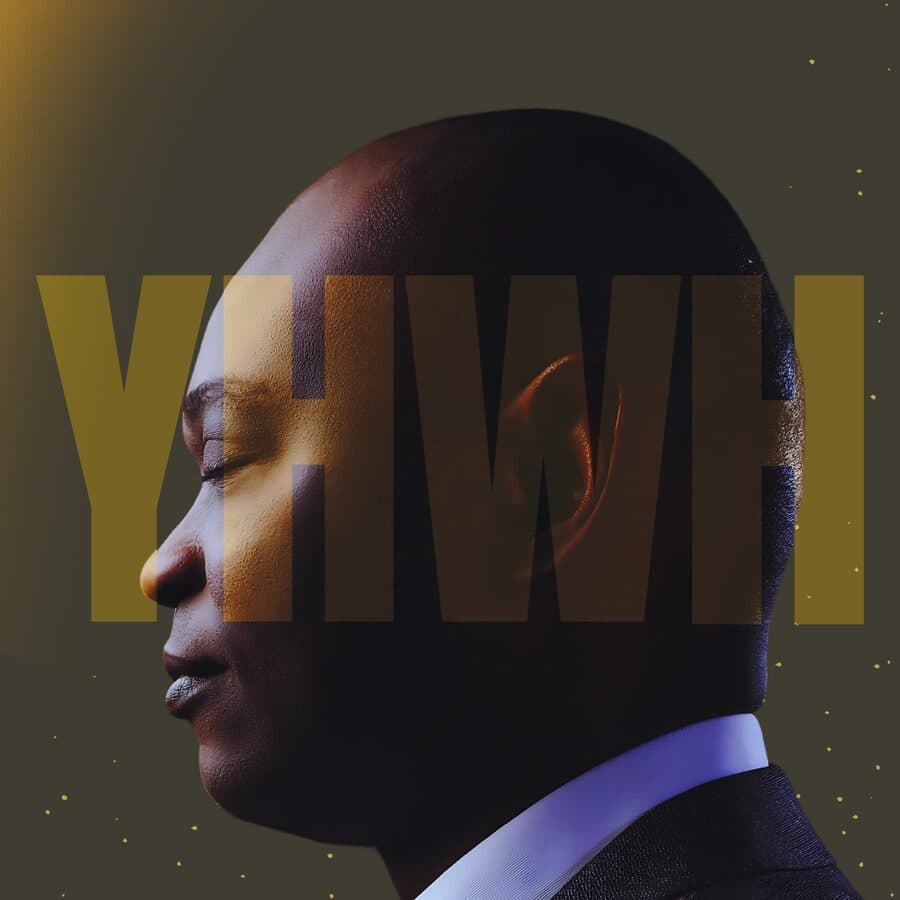
Free downloadMP34:01
YHWH
A comedian’s joke about colonial missionaries sent him looking for the name of God. He found it in his own breathing.
No email, no account, no catch. Yours to keep, and yours to play to a congregation.
It is free, like everything else here. Sing it in a car, in a kitchen, or in front of a congregation, and the genre field on the file will not have made the slightest difference to whether what happened was worship. Only the bowing does that, and I cannot see yours and you cannot see mine.
The short version
The gospel (the announcement, not the shelf) is not a genre. It is a report that a man died, was buried and was raised, and every later use of the word, the music included, is borrowing its authority.
Worship is not a set list. It is a bowed posture and a life at someone's disposal, and the Bible's vocabulary for it is drawn from prostration and paid labour, not from music.
Music sits between the two. It carries the announcement, which is what Tyndale saw when he said the good tidings make a man sing. And it trains the body that Romans 12 says is the actual offering.
Which means the honest order is this. The gospel comes first, because it is a report of something that happened whether anyone sings about it or not. Worship comes second, as the response of a whole life. And the song comes third: real, useful, God-given, worth doing well, and never once the point.
What Jesus called a true worshipper
Everything above is preliminary. Here is the sentence the whole argument is answerable to, and it is Jesus's own definition, given to a woman who had asked him a question about venues:
Yet a time is coming and has now come when the true worshippers will worship the Father in the Spirit and in truth, for they are the kind of worshippers the Father seeks. God is spirit, and his worshippers must worship in the Spirit and in truth.
John 4:23–24, NIVUK
Before the three things I want to draw out of it, here is the verse across seven translations, because two of its decisions belong to the translator rather than to the Greek, and you should be able to see which.
| Version | John 4:23 |
|---|---|
| NIV Anglicised | "Yet a time is coming and has now come when the true worshippers will worship the Father in the Spirit and in truth, for they are the kind of worshippers the Father seeks." |
| KJV | "But the hour cometh, and now is, when the true worshippers shall worship the Father in spirit and in truth: for the Father seeketh such to worship him." |
| ESV | "But the hour is coming, and is now here, when the true worshipers will worship the Father in spirit and truth, for the Father is seeking such people to worship him." |
| NRSV | "But the hour is coming, and is now here, when the true worshipers will worship the Father in spirit and truth, for the Father seeks such as these to worship him." |
| CSB | "But an hour is coming, and is now here, when the true worshipers will worship the Father in Spirit and in truth. Yes, the Father wants such people to worship him." |
| NLT | "But the time is coming, indeed it's here now, when true worshipers will worship the Father in spirit and in truth. The Father is looking for those who will worship him that way." |
| NASB | "But a time is coming, and even now has arrived, when the true worshipers will worship the Father in spirit and truth; for such people the Father seeks to be His worshipers." |
Two things the table settles, and two it does not.
Settled: "true worshippers" is in every one of them, and so is the searching. The Father seeketh, is seeking, seeks, wants, is looking for. Nobody softens either half.
Not settled, first: whether the "spirit" is the Holy Spirit or the human spirit. The NIVUK and the CSB capitalise it; the KJV, ESV, NRSV, NLT and NASB do not. Greek manuscripts do not distribute capital letters for us to read off, pneumati is simply pneumati, so this is a translator's judgement, and it is a real one. I have quoted the NIVUK throughout this article and will not now pretend its capital settles an argument the other five decline to settle. What every version agrees on is the requirement, whichever spirit is meant. And the question has an answer even though the capital does not, which I come back to below.
Not settled, second: whether the English repeats the preposition. The KJV, CSB, NLT and NIVUK give "in spirit and in truth"; the ESV, NRSV and NASB give "in spirit and truth". The Greek has one en governing both nouns, en pneumati kai alētheia, so on this point the versions that do not repeat it are the closer rendering, and the familiar English phrase slightly obscures the thing it is most often used to prove. It is one condition with two halves, not two conditions. Neither half is negotiable. Spirit without truth is atmosphere. Truth without Spirit is a lecture. A room can produce a great deal of the first and a great deal of the second and still not have a true worshipper in it, because the test is not what is happening on the platform.
Now the two that remain, and both are checkable.
"Worshippers" is a noun, and it is a noun the New Testament uses exactly once. Proskynētēs, Strong's 4353, Bible Hub's concordance lists one occurrence in the whole Greek New Testament, and it is here. The Bible has a word for the person rather than the activity, spends it in a single verse, and spends it on this definition. Not "worship leader". Not "worship singer". Not "songwriter", and not "churchgoer" either. Those are all things a person can do on a Wednesday and still not be. Worshipper is what a person is, and Jesus is describing a kind of person, not a kind of song.
"The kind of worshippers the Father seeks." The verb is seeks. God is out looking, and what he is looking for is not a sound. This is the part that should reorganise anyone who works in music for a living, myself first: nothing in that sentence is a description of a repertoire, a genre, a tempo, an arrangement, a chart position or a shelf in a shop. All of that is my trade and I take it seriously. None of it is what is being sought.
Which spirit? The one who makes it possible
I have left that capital undecided because the translators have. But there is a settled fact sitting underneath the unsettled one, and it is the more important of the two.
Whichever noun John 4:23 means, nobody worships without the Holy Spirit. The human spirit, left to itself, does not know how. That is not a hunch of mine; it is Paul saying so:
In the same way, the Spirit helps us in our weakness. We do not know what we ought to pray for, but the Spirit himself intercedes for us through wordless groans.
Romans 8:26, NIVUK
"Helps" is a mild word for what the Greek says. The verb is synantilambanomai, Strong's 4878 (syn, together, on a verb meaning to take hold of) so this is not standing alongside us offering advice. It is taking hold of the other end of the weight. And the admission in the middle of the verse is the whole of my point: we do not know what we ought to pray for. If we do not know how to ask, we certainly do not know how to adore.
There is one place in the New Testament where a worship word is joined directly to the Spirit. Most English readers never meet it as a worship text, because the version they read is the outlier.
| Version | Philippians 3:3 |
|---|---|
| KJV | "For we are the circumcision, which worship God in the spirit, and rejoice in Christ Jesus, and have no confidence in the flesh." |
| ESV | "For we are the circumcision, who worship by the Spirit of God and glory in Christ Jesus and put no confidence in the flesh" |
| NRSV | "For it is we who are the circumcision, who worship in the Spirit of God and boast in Christ Jesus and have no confidence in the flesh" |
| CSB | "For we are the circumcision, the ones who worship by the Spirit of God, boast in Christ Jesus, and do not put confidence in the flesh" |
| NLT | "For we who worship by the Spirit of God are the ones who are truly circumcised." |
| NASB | "for we are the true circumcision, who worship in the Spirit of God and take pride in Christ Jesus, and put no confidence in the flesh," |
| NIV Anglicised | "For it is we who are the circumcision, we who serve God by his Spirit, who boast in Christ Jesus, and who put no confidence in the flesh –" |
Six say worship. The NIV says serve. The Greek verb is λατρεύοντες, from λατρεύω, Strong's 3000, the hired-servant word from the table earlier in this article, followed by πνεύματι Θεοῦ, by the Spirit of God, with no textual variant noted at Bible Hub's interlinear. So the NIV is not wrong: latreuó genuinely covers both English words, which is exactly why the versions divide. But it does mean the one sentence in the New Testament that says plainly we worship by the Spirit of God is invisible to a reader who only has the NIV in front of them.
Then the direction of travel. John 4:23 says it is the Father who is being sought and worshipped, and it is by the Spirit that the word "Father" gets said at all:
The Spirit you received does not make you slaves, so that you live in fear again; rather, the Spirit you received brought about your adoption to sonship. And by him we cry, 'Abba, Father.'
Romans 8:15, NIVUK
Because you are his sons, God sent the Spirit of his Son into our hearts, the Spirit who calls out, 'Abba, Father.'
Galatians 4:6, NIVUK
Even the shortest confession in the faith needs him:
...no-one can say, 'Jesus is Lord,' except by the Holy Spirit.
1 Corinthians 12:3, NIVUK
And now look again at Ephesians 5, which I quoted earlier for its verbs. The imperative governing that whole chain (speaking, singing, making music, giving thanks, submitting) is not sing. It is this:
Instead, be filled with the Spirit,
Ephesians 5:18, NIVUK
The singing hangs off the filling. Never the other way round.
So here is the flat statement, and I make it as a conviction rather than a finding. The Holy Spirit is not an atmosphere a band manufactures once the lights come down. He is the reason worship is possible at all: he takes hold of the other end of it, he supplies the word Father, and he is named in the one verse that says we worship by him. Which makes the aim very simple, and not about us:
And without faith it is impossible to please God, because anyone who comes to him must believe that he exists and that he rewards those who earnestly seek him.
Hebrews 11:6, NIVUK
Pleasing the Father is the object. The Spirit is the help. The song, when there is one, is the overflow.
And note the object
Proskyneó always takes an object. Something is always being bowed to. Which is why the New Testament's sharpest correction on this subject is not about style at all; it is about aim. John, overwhelmed at the end of the vision, falls at the feet of the angel who has been showing him everything:
At this I fell at his feet to worship him. But he said to me, 'Don't do that! I am a fellow servant with you and with your brothers and sisters who hold to the testimony of Jesus. Worship God!'
Revelation 19:10, NIVUK
The messenger was genuine. The vision was genuine. The impulse was genuine. The object was wrong, and that was enough to stop the whole thing.
Paul names the same failure as the root of everything else that goes wrong with people:
They exchanged the truth about God for a lie, and worshipped and served created things rather than the Creator – who is for ever praised.
Romans 1:25, NIVUK
Both verbs in that verse are worship words, sebazomai and latreuó, the second one straight off the table above. The sin Paul is describing is not a failure of sincerity or of volume. It is a redirection. Created things, worshipped.
A song is a created thing. So is a genre, a tradition, a hymnal, a Sunday morning, a sound we grew up with, and a career. Every one of those is a gift and not one of them is the Father. It is possible to love worship music very much and be nowhere near worship, and the reason is not that the music is bad. The reason is that the music was never the object.
We do not worship worship music. We worship the Father.
Come, let us bow down in worship, let us kneel before the LORD our Maker;
Psalm 95:6, NIVUK
Bow down first, to your heavenly Father. Then sing, as quiet or as loudly as you like. Either way, He hears you.
Scripture quotations marked NIVUK taken from the Holy Bible, New International Version Anglicised, Copyright © 1979, 1984, 2011 Biblica. Used by permission of Hodder & Stoughton Publishers, an Hachette UK company. All rights reserved. 'NIV' is a registered trademark of Biblica. UK trademark number 1448790. Quotations marked KJV are from the King James Version, which is in the public domain in most of the world; in the United Kingdom the rights are vested in the Crown. ESV, NRSV, CSB, NLT and NASB wordings are quoted for comparison from Bible Hub's parallel pages for Psalm 22:3 and John 4:23.
Sources
- "Gospel" · Etymonline; εὐαγγέλιον, Strong's 2098 · Bible Hub
- Priene Calendar Inscription and Craig A. Evans, "Mark's Incipit and the Priene Calendar Inscription", Journal of Greco-Roman Christianity and Judaism 1 (2000)
- Tyndale's prologue to the 1525 New Testament
- Philip P. Bliss, Gospel Songs (1874) · Internet Archive; Sankey & Bliss, Gospel Hymns and Sacred Songs (1875)
- Thomas A. Dorsey · BlackPast and the Songwriters Hall of Fame; Michael W. Harris, The Rise of Gospel Blues
- Southern gospel
- The Recording Academy on the Gospel/Contemporary Christian Music field; Hot Gospel Songs methodology; Dove Award for Worship Album of the Year
- Time on the Jesus Is King debate (1 November 2019); Rolling Stone on the Flamy Grant reclassification
- Omotayo O. Banjo and Kesha Morant Williams, "A House Divided? Christian Music in Black and White", Journal of Media and Religion 10:3 (2011)
- Philippians 3:3 parallel translations and interlinear; συναντιλαμβάνομαι, Strong's 4878
- προσκυνητής, Strong's 4353 · Bible Hub, the New Testament's single use of the noun "worshipper"; interlinear of John 4:23 for the single preposition, and the parallel translations of John 4:23 for the comparison table
- Hebrew and Greek word data from Bible Hub's concordance pages: shachah H7812, abad H5647, abodah H5656, yare H3372, proskyneó G4352, latreuó G3000, leitourgia G3009; interlinears for Ephesians 5:19 and Colossians 3:16
- Psalm 22:3 parallel translations, interlinear and commentaries
- Adam Perez, "All Hail King Jesus": The International Worship Symposium and the Making of Praise and Worship History, 1977–1989, PhD dissertation, Duke University (2021)
- Scott Aniol, "Blurring Doctrinal Distinctives with Praise and Worship", summarising Judson Cornwall and citing Bryan Chapell
- Oh Happy Day and Jesus Is King chart data